Garmin Forerunner 970
Choose it for running, triathlon, comfort, lower weight, advanced performance metrics, and better value. It already includes maps, a flashlight, sapphire glass, a titanium bezel, ECG support, a speaker, and a microphone.
Updated: Oct 10, 2026
Garmin Flagship Comparison
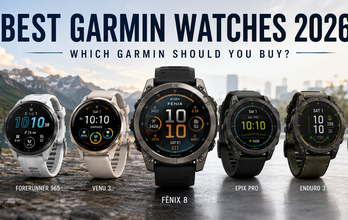
Buy the Garmin Forerunner 970 if running or triathlon is your main priority. It gives you flagship training features, full-color maps, sapphire glass, a titanium bezel, an LED flashlight, a speaker and microphone, and a 1.4-inch AMOLED display in a lighter 56 g package. Buy the Fenix 8 when you need tougher construction, more case and display choices, longer battery life, diving support, or broader outdoor versatility.
If you are still deciding which type of watch suits you best, start with the Smartwatches Hub, the Smartwatch Buying Guide, or the Best Smartwatches 2026. If you already know you want Garmin, use the Garmin Fenix Hub or Garmin Watch Models Explained.
Choose it for running, triathlon, comfort, lower weight, advanced performance metrics, and better value. It already includes maps, a flashlight, sapphire glass, a titanium bezel, ECG support, a speaker, and a microphone.
Choose it for hiking, mountaineering, diving, expeditions, rugged use, more size choices, solar options, and longer battery life. It is the more versatile platform, but many runners do not need the extra hardware.
If you are choosing Fenix 8 over Forerunner 970 mainly because you want Garmin's premium flagship, the timing matters. Garmin has not officially announced Fenix 9, but recent regulatory filings make a near-term launch plausible enough that buyers considering a full-price Fenix 8 should at least think about waiting.
| Category | Fenix 8 | Forerunner 970 | Winner |
|---|---|---|---|
| Running | Excellent | Purpose-built and lighter | Forerunner 970 |
| Triathlon | Excellent | Purpose-built with advanced metrics | Forerunner 970 |
| Hiking and adventure | More rugged with more battery options | Excellent maps and navigation | Fenix 8 |
| Maps and navigation | Excellent | Excellent | Tie |
| Comfort | Heavier | 56 g | Forerunner 970 |
| Battery | Better, especially larger and solar models | Up to 15 days smartwatch / 26 hours GPS | Fenix 8 |
| Durability | Leakproof buttons, stronger water rating, rugged casing | Sapphire and titanium, but lighter construction | Fenix 8 |
| Value | Premium-priced platform | Most flagship athletic features for less | Forerunner 970 |
| Feature | Garmin Fenix 8 | Garmin Forerunner 970 | Better Choice |
|---|---|---|---|
| Primary buyer | Outdoor and multisport athlete | Runner and triathlete | Depends on use |
| Case sizes | 43, 47, or 51 mm AMOLED; 47 or 51 mm solar | 47 mm only | Fenix 8 |
| Display | AMOLED or MIP solar depending on model | 1.4-inch AMOLED, 454 × 454 | Fenix for choice |
| Weight | 47 mm AMOLED: about 73 g titanium / 80 g steel | 56 g | Forerunner 970 |
| Lens | Gorilla Glass or sapphire depending on model | Sapphire crystal | Forerunner standard spec |
| Bezel | Steel or titanium depending on model | Titanium | Depends on Fenix trim |
| Water rating | 10 ATM with dive support | 5 ATM | Fenix 8 |
| Leakproof inductive buttons | Yes | No equivalent dive-focused design | Fenix 8 |
| Maps | Built-in color maps | Built-in color maps | Tie |
| Multiband GPS / SatIQ | Yes | Yes | Tie |
| LED flashlight | Yes | Yes | Tie |
| Speaker and microphone | Yes | Yes | Tie |
| ECG app support | Supported in eligible regions | Supported in eligible regions | Tie |
| Running economy | Not the central differentiator | Supported with compatible HRM | Forerunner 970 |
| Running tolerance | Not the central differentiator | Yes | Forerunner 970 |
| Step speed loss | Not the central differentiator | Supported with compatible HRM | Forerunner 970 |
| Diving | Scuba and apnea features | No | Fenix 8 |
| Smartwatch battery | Varies by size; up to 29 days AMOLED or longer with solar configurations | Up to 15 days | Fenix 8 |
| GPS-only battery | Varies by model; 47 mm AMOLED up to 47 hours | Up to 26 hours | Fenix 8 |
| Best overall value | Best when outdoor hardware is needed | Better for most runners | Forerunner 970 |
Fenix 8 specifications vary substantially by case size, display type, lens, and bezel material. Battery figures are manufacturer maximums and depend on settings and usage.
The Forerunner 970 is the better running watch, even though both models offer high-end Garmin training readiness, recovery, race planning, multiband GPS, maps, and multisport profiles.
The difference is not that Fenix 8 lacks training capability. It is that the Forerunner delivers the capabilities runners actually use in a lighter package. At 56 g, it is much easier to forget on the wrist during long runs, intervals, sleep tracking, and race day than a 47 mm Fenix 8.
Forerunner 970 also introduces running-focused metrics such as running tolerance, running economy, and step speed loss. Some require a compatible heart-rate accessory, but they reinforce the watch’s position as Garmin’s specialist performance tool.
It offers nearly all the flagship functionality runners need with less wrist weight and more running-specific analysis.
If you want to compare Garmin with running-first alternatives beyond this matchup, see the Best Running Watches.
Both watches have built-in color maps, turn guidance, route planning, multiband GNSS, and SatIQ technology. For runners, cyclists, and normal hiking routes, Forerunner 970 is not a stripped-down navigation watch.
Fenix 8 still has the advantage for demanding outdoor use because of its longer battery configurations, stronger water resistance, leakproof buttons, rugged housing, and broader adventure positioning.
The practical buying question is not whether Forerunner has maps—it does. The question is whether you need Fenix hardware around those maps.
For hiking-first buyers who want to compare Garmin against other serious outdoor options, use the Best Hiking Watches guide.
Forerunner 970 delivers up to 15 days in smartwatch mode and up to 26 hours in GPS-only mode. That is enough for daily training, marathons, triathlons, and many ultramarathons.
Fenix 8 is substantially more flexible. Battery life depends on size and display, but larger AMOLED and solar models can run far longer. The 47 mm AMOLED model alone can reach up to 16 days in smartwatch mode and up to 47 hours in GPS-only mode, while 51 mm and solar versions extend endurance further.
Choose Fenix for multiday adventures, long ultras, expeditions, or less frequent charging. Forerunner battery is still sufficient for most athletes.
Forerunner 970 comes in one 47 mm size with a 1.4-inch AMOLED display. It weighs 56 g, making it the easier watch to wear while running, sleeping, and tracking recovery around the clock.
Fenix 8 offers more choice. The 43 mm model fits smaller wrists, the 47 mm is the mainstream size, and the 51 mm prioritizes display presence and battery life. That flexibility is valuable, but comparable Fenix configurations are heavier.
Choose Forerunner for comfort. Choose Fenix if finding the right case size matters more than minimum weight.
Fenix 8 is the stronger outdoor watch. It has a 10 ATM water rating, dive support, leakproof inductive buttons, a protected sensor design, and a casing built for demanding environments.
Forerunner 970 is not fragile. Its sapphire lens and titanium bezel are premium upgrades, and its 5 ATM rating is suitable for swimming. However, it is not intended to replace Fenix for diving, rough expeditions, or the most demanding outdoor use.
The Forerunner is durable enough for normal athletic use, but Fenix has the tougher platform and greater water capability.
Both models include AMOLED options, speaker and microphone, music storage, Garmin Pay, notifications, an LED flashlight, advanced sleep and recovery tracking, and ECG support where Garmin enables the feature.
This reduces one of the old reasons to buy Fenix. Forerunner 970 no longer feels like a basic plastic running watch beside the premium outdoor line. Its sapphire crystal, titanium bezel, flashlight, and voice hardware make it suitable for everyday use.
If sleep, recovery, and passive health tracking matter more than maps, live workout data, or wrist-based navigation, a smart ring may be a better fit than either watch.
Forerunner 970 is the better purchase for runners and triathletes who want Garmin’s premium maps, navigation, health tracking, and smartwatch hardware without wearing a heavier Fenix.
Verdict: Forerunner 970 is the smarter flagship purchase for most runners, triathletes, and fitness-focused buyers.
Fenix 8 is Garmin’s more versatile outdoor platform. It is available in more sizes and display configurations and adds stronger durability, diving support, and significantly better battery potential.
Verdict: Fenix 8 is worth the upgrade when outdoor durability, diving, size choice, or maximum battery life is central to the purchase.
| Buyer Type | Best Choice | Why |
|---|---|---|
| Road runner | Forerunner 970 | Lighter and more running-focused |
| Marathon runner | Forerunner 970 | Comfort, maps, pacing, and advanced metrics |
| Triathlete | Forerunner 970 | Premium multisport training without Fenix weight |
| Trail runner | Forerunner 970 for racing; Fenix 8 for rugged adventures | Choose based on weight versus durability |
| Hiker or backpacker | Fenix 8 | Battery, durability, and outdoor hardware |
| Diver | Fenix 8 | 10 ATM rating and dive features |
| Small-wrist buyer | Fenix 8 43 mm | Forerunner 970 only comes in 47 mm |
| Best value seeker | Forerunner 970 | More flagship overlap for less money |
The Fenix 8 is worth paying more for when you need at least one of these advantages:
It is not worth paying more solely because Fenix is positioned as Garmin’s broader flagship. For runners, Forerunner 970 may actually be the more complete tool for the job.
One more factor in 2026: if the Fenix 8 is at full price and you do not need it immediately, waiting for the still-unannounced Fenix 9 may be more sensible than paying a premium simply to own the current Fenix flagship.
Yes. It is lighter and adds specialized running metrics while retaining maps, multiband GPS, training readiness, a flashlight, and premium materials.
Yes. It includes built-in color mapping and advanced navigation, so maps are not exclusive to Fenix.
Yes. It adds a 10 ATM rating, dive capability, leakproof buttons, and a more rugged casing.
Fenix 8. The exact advantage depends on case size and display, but most Fenix 8 configurations outlast Forerunner 970.
Forerunner 970 is lighter at 56 g and is generally more comfortable for running and sleep tracking.
Most dedicated runners should choose Forerunner 970. Buyers who need stronger outdoor hardware, diving, more battery, or more case choices should choose Fenix 8.
Buy Fenix 8 now if you need the watch soon or find a strong discount. Wait if your current watch still works and you are about to pay full price. Garmin has not officially announced Fenix 9, so treat the wait decision as a timing choice rather than a confirmed-spec comparison.
The Garmin Forerunner 970 is the better buy for runners and triathletes. It is lighter, more comfortable, more running-focused, and now includes many features that once pushed buyers toward Fenix, including maps, sapphire glass, titanium, a flashlight, speaker, and microphone.
The Garmin Fenix 8 is the better outdoor and adventure watch. Buy it for longer battery life, more case and display options, stronger water resistance, diving support, and more rugged construction.
Do not buy Fenix 8 simply because it is Garmin’s broader flagship. Buy it because you need its hardware advantages. Otherwise, the Forerunner 970 is likely the smarter purchase.
If you prefer Fenix 8 but are shopping at full price, consider the timing. The Fenix 9 is still unannounced, but it is plausible enough that buyers who are not in a hurry may prefer to wait before committing to Fenix 8.
Feb 29, 2020

May 23, 2025
Jul 21, 2026
Jul 21, 2026
Jul 21, 2026

Comments: 0