Buy a wet dry floor washer if most of your cleaning happens on sealed hard floors and you regularly deal with crumbs, hair, spills, paw prints, and sticky residue at the same time. Do not buy one as a replacement for a normal cordless or upright vacuum if your home has lots of carpet, stairs, rugs, upholstery, or above-floor cleaning.
Quick Answer: Which Type of Floor Washer Should You Buy?
New Models & Unusual Formats to Know About
These do not all belong in the same ranked shortlist. They matter because each changes a different part of the buying decision: above-floor reach, high-temperature steam, or under-furniture maneuverability.
Unlike a conventional floor washer, AquaReach Pro adds an extendable suction-and-spray wand for baseboards, cabinet doors, tile walls, windowsills, corners, and other above-floor hard surfaces. The Pro WD563 also uses a self-sanitizing dock.
Check Current Price on AmazonDreame H16 Pro Steam is a premium wet-dry steam floor washer for buyers who want high-temperature cleaning, hot-water washing, strong suction, edge reach, and more aggressive scrubbing for sticky or dried-on hard-floor messes.
Tineco FLOOR ONE i7 Fold focuses on reach and maneuverability, using a foldable tube and lay-flat body to clean farther under beds and sofas while keeping the anti-tangle, edge-cleaning, and self-maintenance features expected from a modern FLOOR ONE model.
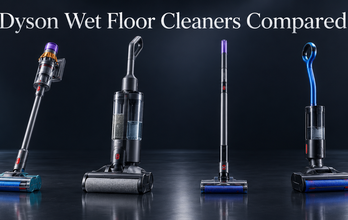
Dyson now has a dedicated floor-washer branch separate from its conventional cordless stick vacuums. Clean+Wash Hygiene is the premium full-size floor washer, while PencilWash is the lighter ultra-slim specialist for sealed hard floors.
Do You Need a Wet Dry Vacuum or a Cordless Vacuum?
Choose a Wet Dry Floor Washer If..
- Most of your flooring is sealed hardwood, tile, vinyl, laminate, or another compatible hard surface.
- You want to vacuum loose debris and wash the floor in the same pass.
- Kitchen spills, pet messes, muddy footprints, and sticky residue are common.
- You do not mind emptying a dirty-water tank after cleaning.
- You are willing to maintain the roller and water system regularly.
Choose a Cordless Vacuum If..
- You have significant carpet, rugs, stairs, sofas, or upholstery.
- You want one machine for floors plus above-floor cleaning.
- Dry debris pickup matters much more than washing.
- You want lighter maintenance with no dirty-water tank.
- You need a primary whole-home vacuum rather than a hard-floor washer.
Buying rule: A floor washer is a hard-floor specialist. If you are still deciding between categories, use the Cordless Vacuum Buying Guide or the broader Vacuum Cleaner Buying Guide before comparing floor-washer models.
Which Dyson Wet Cleaner Fits You?
Dyson now has two different wet-cleaning paths. Clean+Wash Hygiene and PencilWash are dedicated hard-floor washers, while V16 Piston Animal Submarine is a full cordless vacuum system that adds a wet-cleaning head.
Simple rule: Clean+Wash Hygiene is the stronger dedicated Dyson floor washer, PencilWash is the lighter specialist, and V16 Submarine is the better choice when one machine also needs to work as a conventional cordless vacuum. See Dyson Wet Floor Cleaners Compared for the full V16 Submarine vs Clean+Wash Hygiene vs PencilWash vs WashG1 lineup.
Steam vs Hot Water vs Standard Washing
| Cleaning Type | Best For | Main Advantage | Main Trade-Off |
|---|---|---|---|
| Standard washing | Daily crumbs, spills, paw prints, light sticky residue | Simple, fast, and usually the easiest to live with | Less heat for difficult dried or greasy messes |
| Hot-water floor washing | Grease, kitchen film, sticky food residue | Uses heated water during floor cleaning to help loosen messes | More complex heating and water systems |
| Steam wet dry hybrid | Dried-on stains and heat-focused cleaning | Adds high-temperature steam while still collecting debris and dirty water | Not appropriate for every floor; more maintenance and higher cost |
Current premium floor washers make these choices more distinct. Dreame H16 Pro Steam is a true steam + hot-water wet-dry model and belongs with steam vacuum cleaners, not conventional standalone steam cleaners. Roborock also combines steam and hot-water cleaning in the F25 family, while Tineco offers dedicated steam models alongside standard premium floor washers.
Check Floor Compatibility Before Features
Floor compatibility is the first filter, not an afterthought. Most household wet dry floor washers are designed primarily for sealed, non-carpeted floors. Tineco, for example, lists sealed wood, tile, and vinyl as compatible for its FLOOR ONE systems. Other manufacturers publish their own surface guidance.
Tank Size Matters More Than Headline Runtime
A long battery runtime is not useful if the clean-water tank runs dry first or the dirty-water tank fills before you finish the floor. For larger homes, compare battery runtime, clean-water capacity, dirty-water capacity, and water-use efficiency together.
| Your Home | Prioritize | Why |
|---|---|---|
| Apartment / small kitchen | Low weight and compact tanks | Large tanks can make the machine unnecessarily heavy. |
| Average hard-floor home | Balanced tank capacity + easy emptying | Enough capacity for normal rooms without adding excessive bulk. |
| Large open-plan home | Larger clean-water tank + long water runtime | Reduces mid-session refills and dirty-tank stops. |
| Pet-heavy home | Easy dirty-tank access and debris separation | Hair and solid debris make tank cleanup more frequent. |
Edge Cleaning: Look at the Actual Roller Coverage
Wet dry vacuums can leave a visible strip of dirt along cabinets and baseboards if the roller sits too far inside the housing. Better models now offer dual-sided or triple-sided edge cleaning, or mechanical systems that bring the roller closer to the wall.
If your kitchen has long cabinet runs or your home collects pet hair along baseboards, edge cleaning can matter more than a small difference in suction.
Lay-Flat Reach Is Worth Paying For in the Right Home
Lay-flat designs let the body recline low enough to reach under beds, sofas, cabinets, and other furniture while maintaining suction and water pickup. This feature is much more useful than it looks on a spec sheet if hard flooring continues under low furniture.
Do not assume every “flexible” model stays fully functional when flat. Check whether the machine can still deliver water, collect dirty water, and maintain suction in the reclined position.
A newer example is the Tineco FLOOR ONE i7 Fold, which combines a 180° foldable tube with a lay-flat body. That makes it especially relevant for buyers whose main frustration is reaching under beds and sofas rather than maximizing steam or hot-water performance.
Pet Hair and Long Hair: Prioritize the Scraper System
Hair handling is one of the biggest differences between floor-washer platforms. Hair can wrap around the roller, collect around the scraper, block the dirty-water path, or force more manual cleaning after each use.
Self-Cleaning Is Not the Same as Self-Maintenance
Modern docks can wash the roller with hot water, rotate it in both directions, and dry it with heated air. These systems can reduce odor and make daily ownership easier, but they do not eliminate manual maintenance.
Tineco recommends cleaning the brush roller after use, even on models with self-cleaning. Dreame and Roborock similarly provide maintenance instructions for tanks, rollers, filters, and heated systems.
Drying Matters Almost as Much as Self-Cleaning
A washed roller left damp can develop odor quickly. If you clean frequently, a dock with effective hot-air drying can be more valuable than an elaborate app or display.
Look for a drying process that addresses the roller rather than only rinsing it. Faster drying is convenient, but the real goal is to leave the brush and internal path dry enough to reduce odor between uses.
Cleaning Solution: Do Not Treat It Like Regular Mop Detergent
Floor washers circulate solution through pumps, tubing, rollers, and dirty-water systems. High-foam household cleaners can create excessive bubbles, interfere with water pickup, and cause tank problems.
Tineco explicitly advises against third-party solution for its FLOOR ONE systems because excess foam can fill the dirty-water tank quickly. Other brands have their own approved-solution rules.
Which Wet Dry Vacuum Brand Ecosystem Fits You?
| Brand | Best Fit | What Defines the Ecosystem |
|---|---|---|
| Tineco | Polished daily floor washing | Deep FLOOR ONE lineup with polished sensing and self-maintenance, premium S9 models, steam variants, and newer foldable/lay-flat formats such as i7 Fold. |
| Dreame | Feature-heavy premium cleaning | Aggressive premium cleaning with hot water, true steam on H16/Aero models, strong edge systems, lay-flat designs, and hair-management features. |
| Roborock | High-tech heat and maneuverability | F25 family spans standard, hot-water, and steam-oriented models with strong lay-flat and self-maintenance systems. |
| BISSELL | CrossWave-style multi-surface flexibility | Long-running wet-dry ecosystem with HydroSteam options and selected models that also support area rugs. |
| MOVA | Feature-value shoppers | Competes strongly on lay-flat reach, hair handling, self-cleaning, and premium-style features at aggressive positioning. |
| Shark | Floor-to-ceiling versatility | AquaReach Pro adds an unusual extendable suction-and-spray wand, giving Shark a different role from floor-only Tineco, Dreame, and Roborock systems. |
| Dyson | Premium hard-floor cleaning with a separate cordless-vacuum path | V16 Piston Animal Submarine combines dry vacuuming with a wet head, while Clean+Wash Hygiene and PencilWash form a separate dedicated floor-washer branch. See Dyson Wet Floor Cleaners Compared for the full model decision. |
If the choice is specifically between Tineco and Dreame, use the dedicated Tineco vs Dreame Wet Dry Vacuums comparison rather than trying to solve that brand decision here.
Features Worth Paying More For
Features You May Not Need
App connectivity, elaborate displays, voice prompts, very high suction numbers, and the hottest possible steam setting can all sound important without changing your daily cleaning much.
Prioritize floor compatibility, roller design, edge reach, tank usability, lay-flat access, hair handling, and maintenance before paying for software or headline specifications.
Simple Wet Dry Vacuum Buying Checklist
| Question | If Yes | Prioritize |
|---|---|---|
| Mostly sealed hard floors? | Yes | Wet dry floor washer is a strong category fit |
| Lots of carpet or stairs? | Yes | Keep a cordless/upright vacuum as the primary cleaner |
| Greasy kitchen messes? | Yes | Hot-water washing |
| Dried-on stains? | Yes | Steam hybrid, if the floor permits steam |
| Low furniture? | Yes | True lay-flat design |
| Pets or long hair? | Yes | Anti-tangle / hair-cutting scraper |
| Large hard-floor area? | Yes | Tank capacity + water runtime + battery runtime |
| Hate roller cleanup? | Yes | Strong self-cleaning and hot-air drying |
| Sensitive flooring? | Yes | Standard washing over steam unless explicitly approved |
| Want to clean baseboards, cabinet fronts, or tile walls too? | Yes | Floor-to-ceiling wand format such as Shark AquaReach Pro |
| Want a Dyson floor washer? | Yes | Clean+Wash Hygiene for premium full-size cleaning; PencilWash for lightweight specialist cleaning |
Wet Dry Vacuum Troubleshooting & Ownership
A floor washer can clean beautifully when the roller, scraper, water path, and tanks are maintained. When performance changes, diagnose those parts before assuming the machine itself needs replacing.
Would Another Cleaning Tool Fit Better?
FAQ
Is a wet dry vacuum worth it?
Yes if most of your cleaning is on sealed hard floors and you regularly deal with mixed dry and wet messes. It is less useful as a primary cleaner in carpet-heavy homes.
Should I buy steam or hot water?
Choose hot-water washing for grease and sticky kitchen residue. Choose steam when dried-on messes and heat are the main priority and your flooring manufacturer explicitly allows steam.
Can a wet dry vacuum replace a cordless vacuum?
Usually not. Floor washers are built mainly for sealed hard floors. A cordless vacuum is still better for carpets, rugs, stairs, upholstery, cars, and above-floor cleaning.
Do I need to vacuum before using a floor washer?
Not with machines designed to vacuum and wash simultaneously. Large debris or objects that exceed the machine's pickup capability should still be removed first.
Do self-cleaning floor washers still need manual cleaning?
Yes. Self-cleaning helps with the roller and internal wash path, but dirty-water tanks, filters, scrapers, debris channels, and rollers still need regular inspection and manual care.
Can I use any cleaning solution?
No. Follow the machine manufacturer's solution guidance. Excessive foam or incompatible chemicals can interfere with water pickup or damage the system.
What is the difference between Dyson V16 Submarine, Clean+Wash Hygiene, and PencilWash?
V16 Piston Animal Submarine is a cordless vacuum system that also includes a wet-cleaning head, so it still handles carpet, rugs, stairs, upholstery, and normal dry vacuuming. Clean+Wash Hygiene and PencilWash are dedicated floor washers for sealed hard floors. Clean+Wash Hygiene is the premium full-size option; PencilWash is the lighter, slimmer specialist.
Can Clean+Wash Hygiene or PencilWash replace a Dyson cordless vacuum?
Not in a mixed-floor home. They are designed around hard-floor washing and do not replace a normal cordless vacuum for carpet, rugs, upholstery, stairs, mattresses, or above-floor cleaning.
Final Verdict
For most buyers, start with a standard premium wet dry floor washer rather than automatically paying for steam or maximum heat. Prioritize floor compatibility, edge cleaning, lay-flat reach, hair handling, tank usability, and self-drying first.
Move to hot-water washing if grease and sticky kitchen messes are a recurring problem. Choose a steam hybrid only if heat is a genuine priority and your flooring allows it. Once you know which format fits your home, use Best Wet Dry Vacuums for actual model recommendations.
For Dyson buyers: choose V16 Piston Animal Submarine if you still need a true cordless vacuum plus wet-floor cleaning. Choose Clean+Wash Hygiene for a premium dedicated floor washer, or PencilWash when a lighter, slimmer hard-floor specialist fits your home better.
Comments: 0