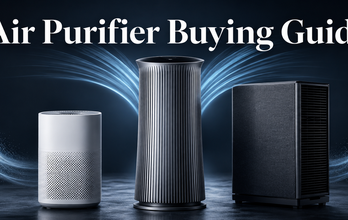
Choose an air purifier around the pollutant you need to remove and the room you need to clean. Room size, airflow, particle filtration, carbon capacity, noise, and filter cost matter more than buying the model with the longest feature list.
Quick Answer: What Should You Prioritize?
1. Start With Room Size, CADR, and Air Changes Per Hour
Do not choose by square-foot coverage alone. Coverage claims can be based on slow air turnover. A better comparison uses CADR and expected air changes per hour (ACH).
| Room Type | What to Prioritize | Why |
|---|---|---|
| Bedroom | Enough CADR for several air changes per hour at a quiet speed | Nighttime usability matters as much as maximum fan power. |
| Living room | Higher airflow and broad placement options | Open spaces usually need more clean-air delivery. |
| Large open-plan area | High CADR or multiple units | One purifier may not move air efficiently across the whole space. |
| Smoke-prone home | Higher ACH | Faster air turnover removes fine particles more quickly. |
2. Match the Filter to the Pollutant
Particles
Dust, pollen, pet dander, fine smoke particles, and many airborne allergens are particle problems. A high-efficiency particle filter is the main tool here.
Gases & Odors
Cooking odors, pet odors, smoke smell, and VOCs require adsorbent media such as activated carbon. A thin carbon sheet is not equivalent to a deep carbon bed.
Buying rule: HEPA and carbon solve different problems. If VOCs or odors are your priority, do not judge two purifiers only by their HEPA claims.
3. HEPA: What Actually Matters
For most particle-focused buyers, a genuine high-efficiency filter is the right starting point. But filter performance depends on the entire purifier: airflow, sealing, fan speed, and how much air actually passes through the filter.
4. Carbon: The Most Overlooked Part of Air Purifier Shopping
Activated carbon is used for odors and gases, but the amount and form of carbon vary dramatically. A purifier with a substantial carbon stage is more relevant for smoke odor, cooking smells, pets, and VOC concerns than one with only a light carbon coating.
5. Smoke vs Dust vs VOCs vs Pet Odors
| Problem | Main Need | Secondary Need |
|---|---|---|
| Dust / pollen | High particle filtration | Enough airflow for the room |
| Wildfire smoke | High CADR for fine particles | Carbon for smoke odor/gases |
| Cooking odors | Activated carbon | Good airflow near source area |
| VOCs | Substantial gas-phase media | Ventilation where possible |
| Pet dander | Particle filtration | Pre-filter for hair |
| Pet odor | Activated carbon | Frequent source cleaning |
6. Noise: Compare the Speed You Will Actually Use
Maximum fan speed is useful for rapid cleanup, but many people run purifiers on medium or low for hours. A quieter purifier at a useful airflow setting can outperform a more powerful machine that you keep turned down because it is too loud.
7. Filter Replacement Cost Can Change the Best Buy
Air purifiers are recurring-cost products. Compare the price and expected life of the main filter, carbon stage, pre-filter, and any proprietary replacement cartridges before choosing the purifier itself.
For premium systems, long-term filter cost can matter as much as the machine price. This is especially important with larger carbon-heavy purifiers.
8. Sensors and Auto Mode: Useful, but Not the Main Reason to Buy
Particle sensors can make auto mode convenient, but not every sensor detects gases, odors, or VOCs well. Auto mode is best treated as a convenience layer on top of good room sizing and filtration.
If your purifier is mainly for smoke or allergies, manual high-speed use during pollution events may still be more effective than relying only on auto mode.
9. What About Ionizers, Plasma, and Other Active Technologies?
Some purifiers add ionization or other active cleaning technologies. These can be secondary features, but they should not replace strong mechanical filtration and proper airflow.
If you prefer the simplest filtration approach, choose a purifier that can run effectively with particle and carbon filtration alone.
10. Placement Matters
Do not wedge the purifier behind furniture or inside a corner where intake and exhaust are blocked. Give it room to move air and place it in the space where you actually spend time.
11. One Large Purifier or Several Smaller Units?
Air does not move perfectly between closed rooms. One powerful purifier in a hallway usually will not clean separate bedrooms as effectively as individual units placed where people sleep.
| Home Layout | Better Strategy | Why |
|---|---|---|
| Open studio | One properly sized unit | Air mixes more freely. |
| Large open-plan living space | One large unit or two medium units | Depends on room shape and airflow. |
| Several closed bedrooms | Multiple smaller units | Cleaner air stays where people sleep. |
| Whole-house smoke concern | Multiple-room strategy | Faster local filtration across occupied spaces. |
12. Premium vs Mainstream Air Purifiers
Premium air purifiers usually justify their cost through some combination of larger filters, more carbon, stronger build quality, quieter high airflow, larger room capability, better sealing, or specialty gas filtration.
Mainstream Purifiers
Best for bedrooms, apartments, everyday dust, pollen, light smoke, and general particle control.
Premium Purifiers
Best for large rooms, heavy smoke, stronger odor/VOC needs, deeper filtration media, or buyers who want longer-duty performance.
Which Air Purifier Brand Fits Which Buyer?
| Brand Type | Best Fit | Typical Strength |
|---|---|---|
| Dyson | Design, sensors, fan + purifier integration | Premium multifunction systems and strong user experience. |
| IQAir | Serious particle filtration | Large filters, premium build, high-end filtration focus. |
| Austin Air | Heavy carbon + simple operation | Deep filter media and strong odor/gas emphasis. |
| AirDoctor | Mainstream premium buyers | Large-room positioning, sensors, accessible premium filtration. |
| Rabbit Air | Design-conscious premium buyers | Wall-mount options, customization, quiet operation. |
| Airpura | Specialty VOC / smoke buyers | Large carbon options and purpose-built filtration variants. |
Simple Air Purifier Buying Checklist
| Question | If Yes | Prioritize |
|---|---|---|
| Large room? | Yes | Higher CADR / airflow |
| Smoke? | Yes | High particle CADR + carbon |
| VOCs / odors? | Yes | More activated carbon |
| Allergies? | Yes | Strong particle filtration + adequate ACH |
| Pets? | Yes | Pre-filter + particle filtration + carbon if odor matters |
| Bedroom? | Yes | Low noise at useful airflow |
| Multiple closed rooms? | Yes | More than one purifier |
| High ownership sensitivity? | Yes | Check filter replacement cost before buying |
Air Purifier Ownership & Troubleshooting
Performance drops when filters clog, airflow is blocked, or replacement intervals are ignored. Before replacing the purifier, check normal maintenance first.
Related Air Quality Guides
FAQ
What size air purifier do I need?
Choose based on CADR and desired air changes per hour, not only the largest square-foot number on the box.
Is HEPA enough for smoke?
HEPA is effective for smoke particles, but smoke also contains gases and odors. A purifier with meaningful activated carbon is more appropriate when odor and VOC control matter too.
Do air purifiers remove VOCs?
Particle filters do not. VOC reduction depends on gas-phase media such as activated carbon or other adsorbents.
Is H14 better than H13?
Not automatically in a complete purifier. Airflow, sealing, filter area, room sizing, and total clean-air delivery matter alongside filter grade.
Should I use one air purifier for the whole house?
Usually not if rooms are closed off. Multiple units placed in occupied rooms are often more effective than one purifier trying to clean air through doorways.
Are expensive air purifiers worth it?
They can be when you need large-room airflow, deeper carbon, specialty gas filtration, quieter high-output operation, or larger filter media. For a normal bedroom, a mainstream model may be enough.
Final Verdict
Choose the purifier by pollutant first, room size second, and brand last. For most buyers, the winning combination is enough airflow for the room, reliable particle filtration, low enough noise to run continuously, and filter costs you are comfortable paying.
Upgrade to a more carbon-heavy or premium system when smoke, odors, VOCs, or large-room performance are the real reason you are buying. Once you know which filtration profile fits your home, move to Best Air Purifiers for actual model recommendations.
Comments: 0