Why Does My Air Purifier Smell?
An air purifier should not become the source of an unpleasant odor. A musty, sour, dusty, smoky, chemical, or burning smell can point to very different causes, so identify the type of odor before replacing parts.
What Does the Smell Tell You?
| Smell | Likely Direction | First Step |
|---|---|---|
| Dusty | Loaded pre-filter/main filter or accumulated dust around the intake | Inspect and clean the permitted components |
| Musty / damp | Moisture, damp filter, humid environment, or contamination near the purifier | Turn it off and inspect for moisture |
| Smoke odor returns quickly | Carbon stage may be saturated or odor source is still active | Remove the source and inspect filter condition |
| Pet / cooking odor | Carbon capacity may be insufficient or exhausted | Check carbon filter and source control |
| New plastic / manufacturing odor | New materials or packaging | Confirm all filter packaging has been removed and ventilate the room |
| Burning / electrical | Possible fan, motor, wiring, or electronics problem | Turn off and unplug |
Step-by-Step Troubleshooting
If it smells electrical, burnt, unusually hot, or the purifier is making a new mechanical noise, unplug it and stop here.
Cooking, smoke, pets, damp fabrics, trash, cleaning chemicals, HVAC odors, and outdoor pollution can all be pulled toward the purifier and make it seem like the machine is creating the smell.
Hair and dust can build up quickly. Clean the pre-filter only by the method allowed for your model.
Look for heavy loading, damage, dampness, unusual discoloration, or a strong odor coming directly from the filter.
If particle filtration still seems normal but odors are no longer controlled, the activated-carbon layer may be exhausted.
Use the exact purifier model and replacement-filter code rather than buying by shape alone.
Why Does My Air Purifier Smell Musty?
A musty smell deserves attention because moisture should not normally be accumulating inside a dry-filter air purifier. Possible sources include a damp pre-filter that was reinstalled before drying completely, unusually humid conditions, moisture entering the unit, or a musty odor elsewhere in the room being drawn through the purifier.
If the main HEPA filter itself becomes wet and the manufacturer does not describe it as washable, replacement is generally safer than trying to wash and reuse it.
Why Does My Air Purifier Smell Like Smoke?
A purifier used around wildfire smoke, tobacco smoke, cooking fumes, or other strong odors can accumulate both particles and gases. The HEPA stage captures particles, while activated carbon is the part designed to adsorb many odors and gases.
Carbon does not regenerate simply because the purifier remains running. Once its adsorption capacity is used up, odor performance can fall even if the particle filter does not look dramatically dirty.
Why Does a New Air Purifier Smell?
Before assuming the purifier is defective, check the simplest issue: was the filter removed from its protective plastic packaging? Many purifiers ship with the filter installed inside the housing but still sealed in plastic.
A mild new-material odor can also occur with recently unpacked products. Ventilate the room and follow the manufacturer's initial-use instructions. A strong electrical or burning smell is different and should not be treated as normal break-in odor.
Can a Dirty HEPA Filter Cause a Smell?
It can contribute, but the smell may come from material trapped on the filter rather than from the HEPA media itself. Dust, smoke particles, pet material, cooking aerosols, and other contaminants accumulate over time.
For the filtration side of the topic, see HEPA Filters Explained: H13, H14 and What Actually Matters.
When the Filter Is the Problem
| Condition | Clean or Replace? |
|---|---|
| Washable pre-filter is dusty | Clean using the permitted method and dry fully |
| Replace-only HEPA filter is heavily loaded | Replace |
| Main filter became wet | Follow manufacturer guidance; replace-only filters should not be washed |
| Carbon no longer controls normal household odors | Replace the appropriate filter/carbon stage |
| Filter is torn, warped, or no longer seals correctly | Replace |
| Filter is relatively new and odor is clearly from the room | Address the source before buying another filter |
Need a New Filter?
If diagnosis points to a loaded or odor-saturated filter, use the exact replacement specified for your purifier. Our Air Purifier Replacement Filters: How to Find the Right One guide explains model numbers, filter codes, OEM versus compatible options, and why filters that look identical may not fit or seal correctly.
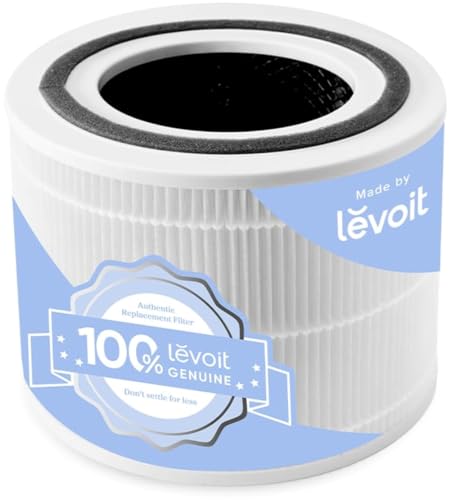
Levoit Core 300-RF
For Core 300-P owners: this is the genuine Levoit Core 300-RF replacement listing for the Core 300-P family.
This is an example of the correct parts-page path: diagnose first, then buy by exact model compatibility. If you own another purifier, do not substitute this filter—find the filter specified for your exact model.
Check Current Price on AmazonAs an Amazon Associate I earn from qualifying purchases.
What If the Purifier Still Smells After a Filter Change?
If a correctly installed new filter does not solve the problem, return to source diagnosis. The odor may be coming from carpet, upholstery, HVAC equipment, a humid area, pets, cooking, smoke infiltration, or another source the purifier is continuously processing.
Also inspect the purifier housing according to the manual. Dust can accumulate on grilles and permitted-to-clean surfaces. Do not spray cleaners or fragrance directly into the purifier.
Do Air Purifiers Remove Odors Completely?
Not necessarily. HEPA filtration is for particles. Odor control depends heavily on gas-phase filtration such as activated carbon, and consumer purifiers vary enormously in how much carbon they contain.
Source control remains important. Removing spoiled food, stopping smoke infiltration, cleaning pet accidents, addressing moisture, or improving kitchen ventilation can matter more than increasing fan speed.
When Should You Stop Using the Air Purifier?
Replace the Filter or Replace the Purifier?
| Situation | Best Next Step |
|---|---|
| Purifier works normally; filter smells or is exhausted | Replace the correct filter |
| Carbon performance is weak but particle filtration is otherwise fine | Replace the filter/carbon stage if it is designed as a combined unit |
| Replacement filters are no longer available | Consider moving to a current purifier ecosystem |
| Purifier has electrical smell or motor problems | Stop using it; service or replace as appropriate |
| Purifier is undersized and odor control has always been poor | Compare a more suitable purifier rather than repeatedly replacing filters |
FAQ
Why does my air purifier smell musty?
Check for moisture, a damp washable pre-filter, a wet main filter, high humidity, and musty sources elsewhere in the room. A dry-filter purifier should not normally stay damp inside.
Why does my air purifier smell sour?
A sour or stale odor can come from contaminants accumulated on the filter or from room air being drawn through the purifier. Inspect the pre-filter, main filter, and surrounding room before replacing parts.
Why does my air purifier smell like plastic?
New materials can produce a mild odor after unpacking. Confirm that all plastic packaging has been removed from the filter. A strong burning or electrical smell is different and warrants shutting the unit down.
Can I spray air freshener into my air purifier?
No. Do not spray fragrance, cleaner, or liquid directly into the purifier. Address the odor source and use the purifier according to its manual.
Can I wash a smelly HEPA filter?
Only if the manufacturer explicitly identifies that exact filter as washable. Most replace-only HEPA filters should not be rinsed.
Why does smoke odor return even though my purifier has HEPA?
HEPA targets particles. Smoke also contains gases and odors that depend on activated-carbon capacity and source control.
Should I replace my purifier if it smells?
Usually not immediately. Diagnose the room, pre-filter, main filter, and carbon stage first. Replacement becomes more reasonable when the machine itself has electrical or mechanical problems, filters are unavailable, or it is fundamentally unsuitable for the room.
Final Verdict
Do not assume every air-purifier odor means “buy a new filter.” Identify the smell, rule out the room itself, inspect the pre-filter and main filter, check for moisture, and consider whether the activated-carbon stage has reached the end of its useful life.
If the filter is the problem, replace it by exact model compatibility. If the odor is electrical or burning, stop using the purifier rather than continuing the normal troubleshooting sequence.
Related Guides
Products covered in this guide
- Levoit Core 300-P Air Purifier Replacement Filter, Genuine Air Filters
- Levoit Core 300-P Air Purifier Replacement Filter, Genuine Air Filters
- Levoit Core 300-P Air Purifier Replacement Filter, Genuine Air Filters
- Levoit Core 300-P Air Purifier Replacement Filter, Genuine Air Filters
- Levoit Core 300-P Air Purifier Replacement Filter, Genuine Air Filters
- Levoit Core 300-P Air Purifier Replacement Filter, Genuine Air Filters
- Levoit Core 300-P Air Purifier Replacement Filter, Genuine Air Filters
- Levoit Core 300-P Air Purifier Replacement Filter, Genuine Air Filters
- Levoit Core 300-P Air Purifier Replacement Filter, Genuine Air Filters
- Levoit Core 300-P Air Purifier Replacement Filter, Genuine Air Filters
- Levoit Core 300-P Air Purifier Replacement Filter, Genuine Air Filters
- Levoit Core 300-P Air Purifier Replacement Filter, Genuine Air Filters
- Levoit Core 300-P Air Purifier Replacement Filter, Genuine Air Filters
- Levoit Core 300-P Air Purifier Replacement Filter, Genuine Air Filters
- Levoit Core 300-P Air Purifier Replacement Filter, Genuine Air Filters
- Levoit Core 300-P Air Purifier Replacement Filter, Genuine Air Filters

Comments: 0