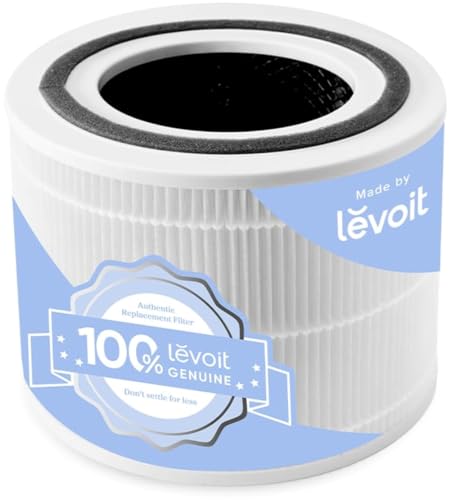
Levoit Core 300
Levoit Core 300-RF
Fits: Levoit Core 300-P family according to the listing.
Filter model: Core 300-RF.
Check Current Price on AmazonUpdated: Oct 17, 2026
Replacement filters are not universal. Even filters that look nearly identical can use different dimensions, seals, carbon layers, or sensor-reset logic. The safest way to buy is by exact purifier model and filter part number—not by shape alone.
A cylindrical filter that looks right may still be too tall, too short, slightly different in diameter, or designed for a different gasket arrangement. Rectangular filters can have the same problem.
| What to Match | Why It Matters |
|---|---|
| Purifier model number | Confirms the product family the filter was designed for |
| Filter part/model number | Best way to distinguish similar filters within one brand |
| Dimensions and shape | Useful secondary check, but not enough by itself |
| Seal / gasket design | Air bypass around the filter can reduce real filtration performance |
| Filter layers | Some replacements combine pre-filter, HEPA, and activated carbon differently |
| Reset instructions | Some purifiers require a filter-life reset after replacement |
| Option | Advantages | Trade-Offs |
|---|---|---|
| Genuine / OEM filter | Lowest compatibility risk, manufacturer-specified fit and filter configuration | Usually costs more |
| Third-party compatible filter | Can reduce ownership cost and may be widely available | Media quality, carbon amount, sealing, and construction can vary |
For air purifiers, fit quality matters more than it does for many simple consumables. Air that leaks around a filter bypasses the filter media completely.
These examples show the kind of model-specific matching you should look for.
Fits: Levoit Core 300-P family according to the listing.
Filter model: Core 300-RF.
Check Current Price on Amazon
Fits: Levoit Core 400S-P according to the listing.
Best for: owners who want a genuine replacement rather than a generic compatible filter.
Check Current Price on Amazon
Fits: Coway Airmega 250 and 250S.
Part number: AP-1720-FP.
Check Current Price on Amazon
Fits: Medify MA-50 purifier family.
Filter stack: pre-filter, HEPA stage, and activated carbon according to the listing.
Check Current Price on AmazonAs an Amazon Associate I earn from qualifying purchases. Always confirm the exact purifier model and filter code before ordering.
There is no universal replacement interval. Filter life depends on purifier design, fan speed, hours of use, indoor particle load, smoke exposure, pets, and whether the pre-filter is maintained.
| Condition | What It Usually Means |
|---|---|
| Filter-life indicator is active | Check the manual and replace if the indicator reflects actual use rather than a simple timer |
| HEPA media is visibly loaded | Replacement may be due, especially if airflow has fallen |
| Odor control has weakened | Activated carbon may be exhausted before the particle filter looks fully dirty |
| Airflow is lower after pre-filter cleaning | The main filter may be heavily loaded |
| Filter is damaged or deformed | Replace it |
Usually not unless the manufacturer explicitly says the main filter is washable. Many consumer purifier HEPA filters are replace-only. Washing them can damage the media, alter the fibers, or affect the filter's shape and seal.
Washable pre-filters are common, but that does not mean the HEPA stage behind them is washable too.
HEPA media targets particles. Activated carbon is used for odors and some gases. Replacement filters can therefore differ even when the HEPA layer looks similar.
If odor control matters, compare whether the replacement contains:
A third-party replacement can physically fit while still changing the purifier's odor performance if the carbon stage is substantially different.
Yes. The wrong filter can affect more than filtration efficiency.
Replacement filters are part of the ownership cost. A purifier that looks inexpensive up front can become costly if filters are expensive or difficult to find.
Before buying a new purifier, check:
This is also why filter efficiency alone should not drive the whole buying decision. For the deeper filtration discussion, see HEPA Filters Explained: H13, H14 and What Actually Matters.
| Situation | Best Decision |
|---|---|
| Purifier works well and only the filter is due | Replace the filter |
| Filter is expensive but purifier still meets your room needs | Compare annual filter cost before replacing the machine |
| Replacement filters are no longer available | Consider a current purifier ecosystem with stable consumables |
| Purifier is undersized for the room | Upgrade the purifier rather than repeatedly buying filters for the wrong capacity |
| Fan, sensor, controls, and filter all need attention | Replacement may make more sense than continued ownership |
Find the exact purifier model number and match it to the replacement-filter model or part number. Do not rely only on brand name or filter shape.
No. Dimensions, seals, filter layers, and housing design vary widely between purifier models.
They can be a good value when they match the exact purifier model and use comparable media, carbon, dimensions, and sealing. Quality can vary more than with genuine filters.
You can often clean a washable or vacuumable pre-filter, but most main HEPA filters are replace-only. Follow the manual for the exact purifier.
Only if the manufacturer explicitly says the exact filter is washable. Many purifier HEPA filters should not be rinsed.
Check whether the replacement includes activated carbon and whether the odor source is still present in the room. HEPA handles particles, not gases and odors by itself.
Yes, if your purifier uses a resettable filter-life indicator. Follow the model-specific reset procedure after installing the new filter.
Buy air purifier filters by exact model compatibility, not by appearance. Match the purifier model and filter code first, then compare genuine and third-party options.
OEM filters are the lowest-risk choice when the price is reasonable. Third-party filters can save money, but only if fit, sealing, media, and carbon configuration are appropriate for the purifier.
If replacement filters are becoming expensive, unavailable, or difficult to match, factor that into whether keeping the purifier still makes sense.
Aug 26, 2026
Aug 24, 2026
Aug 24, 2026
Comments: 0