Steam Cleaner Maintenance at a Glance
| Maintenance Task |
Why It Matters |
Safe Default |
| Use the correct water |
Reduces mineral buildup and steam-path restrictions |
Follow the manual; distilled/demineralized water is recommended by several major brands/models. |
| Empty/manage water tank as instructed |
Reduces stagnant water and keeps valves/tank components clean |
Follow model-specific storage instructions. |
| Clean steam outlet/nozzle |
Mineral deposits or debris can reduce steam flow |
Unplug, cool completely, then clear only as the manufacturer directs. |
| Wash/replace pads |
Dirty pads redeposit soil and reduce cleaning performance |
Wash separately according to the care instructions; replace when worn. |
| Descale |
Protects heaters and steam pathways on machines that require it |
Use only the model-approved procedure or cartridge. |
| Check seals/caps |
Poor sealing can cause leaks or steam loss |
Inspect for damage and replace exact compatible parts if necessary. |
Do You Actually Need to Descale Your Steam Cleaner?
Not every steam cleaner is manually descaled in the same way. The first question is how your machine manages mineral buildup.
| System |
Typical Maintenance Approach |
Example |
| Distilled-water prevention |
Use distilled/demineralized water to reduce mineral accumulation; clean steam outlets when required. |
Many BISSELL steam mops recommend distilled or demineralized water. |
| Water-only steam mop |
Use only the permitted water and avoid chemicals/vinegar in the tank. |
Shark Steam & Scrub guidance specifies distilled water and warns against vinegar/chemicals in the tank. |
| Descaling cartridge |
Replace the cartridge at the manufacturer's interval instead of improvising a liquid descaler. |
Kärcher SC-series machines can use dedicated decalcification cartridges depending on model. |
| Manual descaling procedure |
Follow the exact manual if the manufacturer supplies a tank/boiler descaling method. |
Varies by steam cleaner. |
Do Not Put Vinegar in the Tank Unless the Manual Says To
This is the biggest maintenance mistake to avoid. Vinegar is often suggested online as a generic appliance descaler, but steam-cleaner manufacturers do not treat it universally.
BISSELL's support guidance for several SteamReady/Steam Mop models allows white vinegar to be poured through a detached mop head to clear a clog, while explicitly saying not to run vinegar through the machine. Other current BISSELL steam products say to use water only and warn against formulas or mixtures in the tank.
Shark's Steam & Scrub guidance is stricter: use distilled water and do not add cleaning solution, perfume, oil, vinegar, or other chemicals to the water tank.
Permanent rule: “vinegar can clear this detachable component” does not mean “vinegar is safe in the boiler or tank.” Treat those as completely different procedures.
How to Maintain a Steam Cleaner Safely
Check the manual for water type.
Use distilled or demineralized water when recommended. BISSELL recommends it for several current steam cleaners, and Shark recommends distilled water for certain models or hard-water areas.
Keep the water tank and cap clean.
Inspect valves, caps, and tank seating for scale or debris. Do not add detergent or fragrance unless the machine is specifically designed for it.
Clean steam outlets only after cooling.
Unplug the cleaner and let it cool completely. Some BISSELL troubleshooting guides instruct owners to clear a spray tip with a paper clip, but use that method only where your model instructions allow it.
Wash pads after dirty jobs.
Reusable pads collect grease and soil. Follow the washing instructions and avoid fabric additives that can coat the fibers if the manufacturer warns against them.
Replace cartridges or filters when required.
Some Kärcher steam cleaners use a dedicated decalcification cartridge. Do not replace it with a generic liquid descaling routine.
Store the machine dry and clean.
Follow the model's storage procedure, especially for remaining water, removable tanks, pads, hoses, or attachments.
Should You Use Distilled Water?
Often yes, especially in hard-water areas—but follow the manual. BISSELL recommends distilled or demineralized water for several steam mops, including PowerFresh Slim/Heavy Duty and SpinWave SmartSteam. BISSELL says distilled water helps optimal steam performance and can prolong machine life on the SmartSteam platform.
Shark also recommends distilled water on several steam-mop models and specifically instructs users of some Steam & Scrub models to use distilled water only.
Why it helps: distilled water contains far fewer dissolved minerals than typical tap water, so there is less mineral material available to accumulate inside a heated steam path.
What to Do if Your Steam Cleaner Has Weak or No Steam
| Symptom |
Check First |
Do Not Assume |
| No steam at all |
Power, water level, tank seating, cap, trigger/control, heat-up time |
That the heater is scaled and needs vinegar. |
| Steam at main outlet but not mop head |
Mop-head steam channels / detachable component blockage |
That the entire machine needs replacing. |
| Weak steam |
Water type, steam mode, outlet blockage, scale-management system |
That stronger chemicals are needed. |
| Steam leaks around cap |
Cap seating, seal, tank fill level |
That it is safe to keep operating. |
| Sputtering / water spray |
Overfilling, warm-up, tank setup, model-specific instructions |
That the machine needs extra solution. |
BISSELL's current SteamShot troubleshooting, for example, warns that overfilling can cause leaking, water spray, or sputtering and instructs owners to use distilled water without added chemicals.
How Kärcher Descaling Cartridges Work
Some Kärcher steam cleaners manage scale with a replaceable decalcification cartridge. That changes the maintenance path completely: instead of pouring a home-made descaler into the machine, you replace the cartridge specified for the exact cleaner.
Kärcher's current SC 1 cartridge guidance says its cartridge provides automatic, continuous descaling and recommends replacement after about four months or 15 liters of water use for the compatible SC 1 Upright / SC 1 Multi family.
Compatibility matters: Kärcher uses different cartridge part numbers across steam-cleaner families. Match the exact machine and cartridge number before ordering.
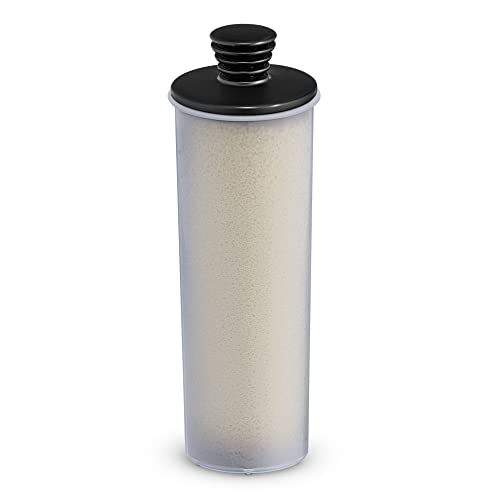
Kärcher SC 3 Decalcification Cartridge
Most steam cleaners do not need a generic “descaling product” recommendation. A replaceable cartridge is different because it is an exact part in the machine's scale-management system.
Genuine Kärcher Part
Kärcher SC 3 Decalcification Cartridge
KärcherSC 32.863-018.0ASIN B00QM98Q1S
Kärcher part 2.863-018.0 is a replacement decalcification cartridge for compatible SC 3 steam cleaners.
Compatibility: check that your exact Kärcher model uses cartridge 2.863-018.0 before ordering. Not every SC-series cleaner uses the same cartridge.
Check Current Price on Amazon
As an Amazon Associate I earn from qualifying purchases. Compatibility and availability can change; verify the exact steam-cleaner model before ordering.
How to Maintain Steam Mop Pads
Dirty pads do not cause internal scale, but they can make a well-maintained steam mop clean poorly. Wash reusable pads according to the manufacturer instructions after dirty cleaning sessions and replace them when the fibers become worn, matted, or no longer absorb and scrub effectively.
Shark advises machine-washing Dirt Grip pads separately with warm water and liquid detergent, while avoiding bleach, powdered detergent, and fabric softener because coatings can reduce cleaning performance and absorbency.
If the pad is the problem rather than the steam system, replace the exact model-compatible pad rather than descaling the machine unnecessarily.
How Often Should You Descale a Steam Cleaner?
There is no universal calendar interval. It depends on water hardness, usage, and the machine's scale-control design.
| Machine Type |
Best Rule |
| Uses a descaling cartridge |
Replace at the manufacturer's stated interval or usage limit. |
| Manufacturer recommends distilled water |
Use the recommended water consistently and follow model-specific blockage/descaling instructions if steam declines. |
| Manual boiler descaling required |
Use only the exact procedure and descaler specified in the manual. |
| No descaling instructions found |
Do not invent a vinegar or chemical treatment; use manufacturer support before putting anything other than approved water in the machine. |
When Maintenance Is Not Enough
Maintenance is worth trying when the machine still heats, the tank and controls work, and the problem points to a dirty pad, blocked outlet, mineral buildup, or consumable part.
A new machine becomes more reasonable when the heater, pump, tank, seals, cord, electronics, or multiple major components are failing and manufacturer troubleshooting does not resolve the problem.
If replacement makes more sense than repair, use the Steam Cleaner Buying Guide: Steam Mop vs Handheld vs Multipurpose to choose the right format rather than automatically buying the same type again.
FAQ
Can I put vinegar in a steam cleaner?
Not as a universal rule. Some BISSELL support procedures use white vinegar only through a detached mop head to clear a clog and explicitly say not to run vinegar through the machine. Shark warns against adding vinegar to the water tank on its Steam & Scrub models. Follow your exact manual.
Should I use distilled water in a steam cleaner?
Use it when the manufacturer recommends it. BISSELL recommends distilled or demineralized water for several steam cleaners, and Shark recommends distilled water for certain models and hard-water conditions.
How do I know if my steam cleaner has scale buildup?
Reduced steam flow can be one symptom, but clogged outlets, low water, tank seating, caps, steam settings, or other faults can look similar. Diagnose the machine before assuming scale is the cause.
Can I use descaling solution in any steam mop?
No. Only use a descaling liquid, tablet, or cartridge if the manufacturer specifies it for the exact machine.
How often should I replace a Kärcher descaling cartridge?
It depends on the model. Kärcher's SC 1 cartridge guidance, for example, recommends replacement after about four months or 15 liters of water use. Other Kärcher steam cleaners may use different parts or intervals.
Why is my steam cleaner not producing steam?
Check water level, tank seating, power, controls, heat-up time, steam outlets, and model-specific troubleshooting first. A mineral clog is only one possible cause.
Bottom Line
Do not treat steam-cleaner descaling as a universal vinegar routine. The safest maintenance plan is model-specific: use the recommended water, keep tanks and steam outlets clean, wash pads correctly, and replace dedicated descaling cartridges where the machine uses them.
If steam output falls, diagnose the tank, cap, nozzle, mop head, and steam path before adding chemicals. When the manufacturer says water only, use water only.





Comments: 0